
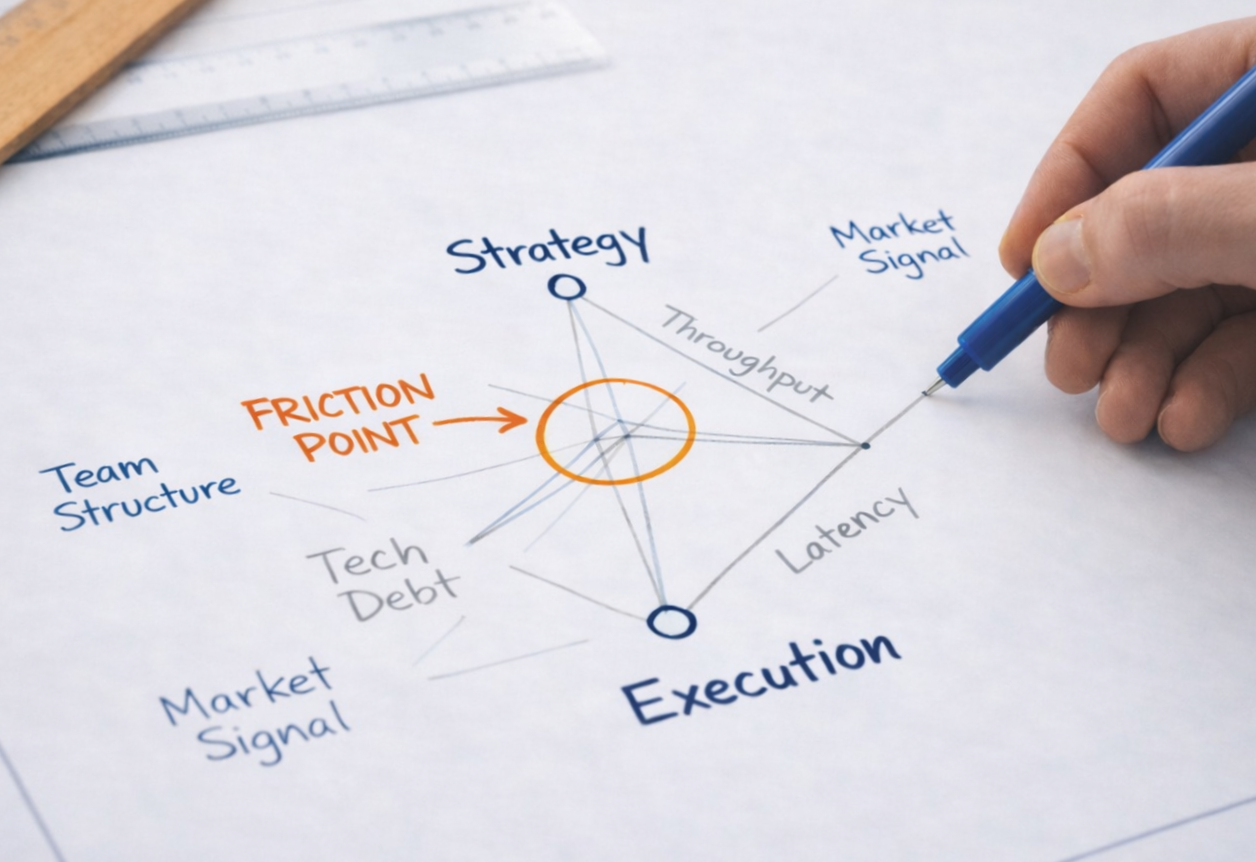
When the Strategy is clear,
but the Execution feels heavy.
Strategic Advisory for Leaders navigating the friction between Strategy, Code, and People.
The Growth Paradox:
Why adding headcount compounds
the coordination tax.
You have the vision. You have the capital. You might even have the team. Yet, instead of acceleration, you feel drag. Deadlines slip, quality drifts, and the gap between what your strategy demands and what your technology delivers keeps widening.
This isn't a failure of talent (though that's what everyone will assume). It's an architecture mismatch—the kind of systems problem that doesn't show up in any sprint retrospective.
For the Scale-Up Leader
"We doubled the engineering team, but our shipping velocity slowed down."
The hidden cost of entropy.
For the Non-Tech Founder
"We bought the software, but the problem didn't go away."
Technology is often a patch for operational dysfunction. You can't automate a broken process.
For the Visionary CTO
"I'm drowning in politics instead of building the future."
When the organizational structure doesn't match the software architecture.

The Engineer in the Boardroom.
I am an engineer by trade and by nature. I spent the first half of my career in the unforgiving world of embedded systems, where a single bug meant hardware failure. That experience wired my brain for craftsmanship and safety-critical thinking.
Then I became a manager. I struggled for three years—not because management was difficult, but because I initially thought it was about holding meetings and writing reports. I wasn't prepared for the human complexity or the sudden leap to managing other managers. Without mentors, I had to learn the hard way: businesses are systems like any others, just with human beings as agents (and that’s about to change again).
That insight changed everything. I learned to design teams the way I designed products, optimize organizational structures the way I optimized code, and architect culture the way I architected software platforms.
I don't offer generic "hustle" advice or studio-perfect slide decks. I offer Compassionate Honesty—the kind that validates the difficulty of your problem before critiquing the solution.
I look at your organization with the curiosity of an engineer taking apart a clock (not the impatience of someone who thinks they already know what's broken). I trace the dependencies, I test the load-bearing walls, and I help you find the one loose gear that is causing the whole mechanism to grind.
Whether you are a tech company facing technical debt or a traditional business adopting digital tools, the principle remains the same: Structure precedes scale. You cannot build a skyscraper on a foundation designed for a cottage (though many try, and I've seen the wreckage).
What I offer
25+ Years. 3 Industries.
1 Engineering Mindset

Automotive

Consumer Electronics

Scholarly Publishing
NEW! Engineering the AI Transformation
AI adoption isn't a technology installation—it's a systems refactoring. The organizations that succeed won't be those who move fastest (despite what the breathless LinkedIn posts suggest), but those who architect the integration correctly.
You can't bolt AI onto a processes designed for humans and expect transformation. You must engineer the transition, and that means treating AI as what it actually is: a new constraint requiring architectural thinking, not a magical productivity elixir.
These are systematic interventions for the specific architecture challenges AI introduces to your organization.
AI Readiness Audit
For SMEs & Scale-ups
Don't build AI on bad data (it will just hallucinate faster). Before you deploy GenAI tools or agents, you need a reality check on your infrastructure. We assess your data maturity, workflow readiness, and organizational capability to absorb the transformation, because capability isn't just about technology, it's about whether your organization can handle the change.
Deliverable:
Data Maturity Scorecard & Gap Analysis
Agentic Workflow Architecture
For Operations-Heavy Businesses
Replace "RPA" with "Reasoning." This isn't about chatbots; it's about designing hybrid workflows where humans handle edge cases and agents handle the grind. We architect autonomous workflows that deliver real operational leverage.
Deliverable:
A deployed, autonomous workflow system
AI-Augmented SDLC
For Software Teams
Multiply your senior engineers. We redesign your development lifecycle for the Copilot era—from requirements through code, testing, and documentation. This is about increasing throughput without sacrificing quality standards.
Deliverable:
An "AI-First" Development Process
AI is refactoring every organization right now.
This is not hype—it's a structural shift in how work gets done. The organizations that architect this transition systematically (treating AI as an organizational constraint, not just a feature) will dominate their industries. The rest will accumulate friction they can't afford.
Choose your intervention
1. Identify the Constraint
For Scale-Ups & Non-Tech Businesses
Before we build, we must understand. Whether it's a software team that's stuck or a business process that resists automation, we start with a deep MRI of the system. (Diagnosis before prescription—a principle honored more in theory than practice.)
2. Architect the Solution
For Founders & Leaders
You need a partner who can translate "Boardroom Vision" into "Engine Room Logic." I act as your fractional VPE or strategic advisor—building the operating system for your engineering organization, not micromanaging the daily work (which you neither need nor want from a consultant).
3. Build the Future
For Growing Organizations
Don't scale on a broken foundation (it will crack spectacularly at the worst possible time). We architect the organizational systems that will carry you from "tribe" to "company" without breaking what made you successful in the first place.
Like technical debt, organizational dysfunction compounds.
Every quarter you operate with misaligned architecture between your strategy, your team structure, and your technology stack, the repair cost increases. Refactoring is cheaper now than it will be after the next growth phase.